
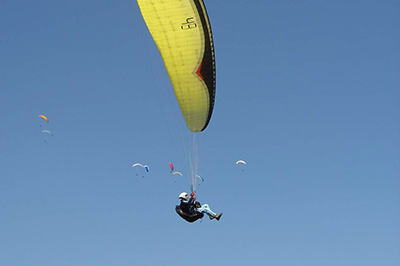
5天前,10月20日,一荷兰籍飞行员用Sport3(之前学习时用Skywalk Mescal)在教练的指挥下进行螺旋训练,在500米高度进入螺旋过猛,由于螺旋速度过快G过载导致脑缺氧失去知觉,据目击者报告当事人在螺旋中双手下垂头部后仰。在距离水面50米时伞突然间进一步加速,最终飞行员以腿部先入水的姿势高速撞击海面。由于Oludeniz高效的快艇救援系统,飞行员迅速被捞起,救起后飞行员还有呼吸,但随后在医院因颈部创伤不治身亡。
ps: 十分不幸,但是似乎每隔不久就有新人不能承受G过载导致的事故。建议新人要练这个动作的话,一定缓慢拉刹车,从360过渡进入。人的体质还是有很大的差别的。我试过这个事故报告中进入螺旋的方法,在猛拉一次刹车之后,伞在第一次俯冲就进入了螺旋,比较猛烈,前沿对地平线只有大约15度角,我当时有明显的缺氧反应,视野收缩,边缘地区变灰,然后明显心虚,赶紧改出....
原文如下:
=====================================
Here is the Dutch explanation:
http://www.e-lijn.nl/cgi-bin/ultimatebb.cgi?ubb=get_topic;f=1;t=001412;p=1#000000
I will try to translate it, but my English is not so good.
On Friday October 20, 2006, Marius van der Sandt had an accident and died later from his injuries.
He made his 31st flight in ideal circumstances. He made his flights on his own Airware Sport 3 L (he learned to fly on a Skywalk Mescal L).
His instructors explained everything technically about the spiral Marius was going to do. They made sure he understood everything.
He made his first spiral at 1000 m. above the sea. Everything went well, and the second time, too. On maybe 500 meters above the sea, he could do it once again. He turned his 'circles' very quietly, really not intense. When he got the instruction to 'stop' the spiral, he didn't react. The instructor gave him instructions over the radio, more and more 'pressing'. At the end he said: throw your reserve. But no reaction.
Another student flew above him and saw that Marius weak (is that the right word?). His head hung backwards and his arms downwards. In the last 50 m, the spiral accelerated, maybe because he was hanging low to one side. He impacted the water very hard, first with his leg, then his head made a hard movement and hit the water.
The boat was directly with Marius and picked him out of the water. Marius was unconscious. He was resucitated and started to breathe by himself again. But he later died of his injuries; his brain got too little oxygen, because of severe injuries in his neck.
If you have any further questions, ask them, although I don't know more (yet) than I have written above.
怕
怕怕
谢谢拷贝猫的及时转帖。。。让我好好冷静冷静。。。
听很多人说过螺旋做太深的话,会导致人失去知觉,但不知道这个度是多少。。。我还是小点转转。。。
恐怖。。。太恐怖了。。。
八两!你上次做到呕吐就是大脑缺氧的征兆呀!
谢谢拷贝猫的转贴.
心情沉重.500米高度进入,还是在水面......

还是悠着点的好.
高速撞击水面,比撞地强不了多少!
我做到很大时,我非常肯定地知道,当时我只要头往后一仰,我就可能晕过去。
螺旋危险,过快会晕,道理简单!做科目还是要有完善计划才行!
有關資料:
On Friday October 20, 2006, Marius van der Sandt had an accident and died later from his injuries.
He made his 31st flight in ideal circumstances. He made his flights on his own Airware Sport 3 L (he learned to fly on a Skywalk Mescal L).
His instructors explained everything technically about the spiral Marius was going to do. They made sure he understood everything.
He made his first spiral at 1000 m. above the sea. Everything went well, and the second time, too. On maybe 500 meters above the sea, he could do it once again. He turned his 'circles' very quietly, really not intense. When he got the instruction to 'stop' the spiral, he didn't react. The instructor gave him instructions over the radio, more and more 'pressing'. At the end he said: throw your reserve. But no reaction.
Another student flew above him and saw that Marius weak (is that the right word?). His head hung backwards and his arms downwards. In the last 50 m, the spiral accelerated, maybe because he was hanging low to one side. He impacted the water very hard, first with his leg, then his head made a hard movement and hit the water.
The boat was directly with Marius and picked him out of the water. Marius was unconscious. He was resucitated and started to breathe by himself again. But he later died of his injuries; his brain got too little oxygen, because of severe injuries in his neck.
If you have any further questions, ask them, although I don't know more (yet) than I have written above.
The spiral dive is one of the most effective rapid descent manoeuvres in emergencies. But they can also kill. Bruce Goldsmith takes a look at what’s going wrong
Over the last year there have been several fatal accidents that appear to have been caused directly by spiral dives. Most of the cases involve low-airtime or intermediate pilots flying gliders rated DHV1 or DHV1-2.The pilot, often receiving instruction on the radio or simply trying out spirals on their own, enters a severe spiral, and continues in the spiral all the way to the ground.
With a descent rate of 10-20m/s impact with the ground, and even water is mostly fatal. This year alone I have heard of three such fatalities in France, two in Germany, one in Italy and one over water in Turkey. All the accidents involved gliders from different brands, the only common thread being the fact that all were intermediate wings certified DHV1 or 1-2. The problem is not new. I remember hearing about the first fatal accident from a spiral dive in St André Les Alpes about eight years ago. The pilot was also under instruction, and on an XC course with a very experienced instructor. He entered a spiral from which he never recovered.
WHAT IS SPIRAL STABILITY?
Certified gliders are tested for spiral stability by the certifying organisation, be it AFNOR or DHV. The test pilot puts the glider into a spiral in a standard way, as defined by the test protocol, and then releases the brakes.
If the glider pulls out of the spiral dive automatically without input from the pilot, then the glider passes the test. If the glider continues in the spiral with the same rate of turn the glider is said to be ’spiral neutral’. If the glider actually accelerates into the spiral once the pilot has released the brakes then the glider is spirally unstable.
Beginner gliders are required to recover immediately, on their own, and advanced gliders are allowed to be spirally unstable as long as it is easily controllable. Intermediate gliders lie somewhere between these two extremes.
All this sounds straightforward enough. So why is it that people are having accidents involving spiral dives on certified wings? To find the answer, we have to look deeper into the background, as what appears to be simple on the surface is actually much more complicated.
HISTORY
In 1997 a team from the technical department of the DHV, headed by Hannes Weininger, made an in-depth investigation into the spiral stability of gliders. The spiral dive was at the time already considered a problem, particularly on low aspect ratio gliders. The DHV were finding that many gliders were spirally unstable. During testing the DHV were failing nearly
all low aspect ratio gliders as a result of their spiral
dive characteristics.
In an over the nose spiral the speed of descent is very high indeed, normally over 20m/s.
In the end the DHV came to the conclusion that practically any low aspect ratio glider would fail if the descent rate was high enough. As a result they decided to fix the descent rate at a level they felt was more reasonable.
They measured the spiral dives made by recreational pilots during SIV courses and found that most spiral dives didn’t go above a 14m/s descent rate. So now the DHV test is based on recovery from a normal spiral with a descent rate of 14 m/s.
The DHV test also says that even if a glider is spirally unstable in spirals of over 14 m/s then the wing must be easy to control in order to achieve a DHV1 or 1-2 grade.
During the course of this investigation the DHV also discovered that there are two types of spiral dives: the ’standard spiral’, and the ’over-the-nose spiral’.
THE STANDARD SPIRAL:
To enter a standard spiral, apply one brake smoothly and progressively. As you do this the bank angle of the glider tends to increase progressively in line with the severity of the spiral. The leading edge is typically at 45 degrees to the horizon, and it is normally difficult to exceed a descent rate of 15m/s.
OVER-THE-NOSE SPIRAL:
This is achieved by doing one 360-degree turn in a standard spiral and then applying one brake abruptly so that the leading edge rotates though 45 degrees and faces towards the ground. This is very similar to the SAT entry, though when you enter a SAT you apply the brake for longer so that the leading edge goes past the point where it is facing the ground. In an over the nose spiral the speed of descent is very high indeed, normally over 20m/s.
THE DHV’S CONCLUSIONS:
As a result of the investigation, the magazine DHV Info published two articles on the subject - one by Christoph Kirsch (Freex designer) and another by Stefan Muller (Firebird designer) during 1988. Basically both said that the spiral dive was a dangerous manoeuvre and should only be practiced in emergency situations.
...DHV only tested gliders to a descent rate of 14m/s and that above this descent rate the stability characteristics could be very different.
They also pointed out that the DHV only tested gliders to a descent rate of 14m/s and that above this descent rate the stability characteristics could be very different.
The DHV recommend that spiral dives should only be taught over water on SIV clinics and not to beginners. They added that spiral dives should only be used as an emergency procedure and, in any case, recommend all pilots exit a spiral at least 300 metres above ground level.
OTHER FACTORS AFFECTING SPIRAL STABILITY:
All this sounds complicated enough but added to this there are many other important variables that effect spiral stability:
1 Chest strap setting on the harness: The wider you have set your chest strap, the better your glider will recover from spirals. Since intermediate pilots generally fly with a narrower chest strap setting, this could well be one of the contributory factors in some of the fatal accidents.
2 Weight: Gliders are more spirally unstable when the wing is more highly loaded.
3 Cross bracing makes a glider more spirally unstable. This includes ABS, which most pilots use.
4 The speed with which a pilot applies the brakes when entering a spiral.
5 The amount of weight shift applied as a pilot enters a spiral, as well as the amount used once established in
the spiral.
6 The centre of gravity of the pilot. The lower the C of G is, the more likely the glider will be to stay in a spiral. This is very important when considering where to position any ballast.
The certification bodies do their best to test gliders in a standard way that reflects the way pilots fly their gliders in practice. However, with all these variables, it’s easy to see how a certified glider could be found to be spirally unstable under certain circumstances.
Due to the increasing number of accidents involving issues of spiral stability the DHV are making the certification tests more and more severe with regard to spiral stability. Gliders that would have passed DHV1-2 a year ago would now no longer pass at the same rating.
RECOMMENDATIONS:
I suspect that intermediate pilots accidentally entering an over-the-nose spiral cause many of the fatal accidents that we are seeing now on intermediate wings. The speed of descent and the high G-forces surprise them so much that they freeze and do nothing all the way to the ground. This is clearly a very unhealthy situation! Fortunately pilots can avoid this problem by following a few simple guidelines.
1 The spiral dive is an advanced flight manoeuvre and should not be taught to low airtime students.
2 Spirals should be first practised over water on SIV courses before they are done over the ground.
3 To exit from a spiral all you need to do is to weight shift and steer out of the turn. The earlier you exit the spiral the easier it is.
4 In spirals of particularly high descent rate, the brake pressure may become very high and the pilot may be physically unable to apply enough outside brake. In this case first try using both hands on the outside brake. If all else fails, throw your reserve. Many of the pilots that died from spiral dives this year never threw their reserve parachutes. Remember, high G-forces can stop you thinking straight.
"Gliders that would have passed DHV1-2 a year ago would now no longer pass at the same rating." [reply] 25-Feb-04
That line must create a few collywobbles around the paragliding world!
And how do we determine which these might be? A Vibe, for instance?
D
G forces. [reply] 26-Feb-04
Hi bruce.
I wonder if the G forces in a deep spiral are enough to couse a lost of counscience, something like the NASA pilots experiment when they are in the centrifuge machine... has someone messured the G forces? i know there is something like a vario, that was made for that. Tha could be a reason for those accidents.
Chema
Re: G forces. [reply] 01-Mar-04
I once performed an nose-down spiral with a Swing Astral1. It was videoed such that I could afterwards analyse it. Descent rate 20m/s, G 4.5, rotation 1/sec (!).
This was during an SIV and the instructors said there was no limit to how hard I could spiral. Later i have learned better. I hesitate to take my Octane beyond 12m/s.
Re: G forces. [reply] 06-Apr-04
Good Point!
I know of at least one case where the pilot faded out while spiralling. This was at a SIV training over water. The pilot hit the water spiralling. Fortunately he did not suffer any major injuries and was recovered by the safety boat.
Martin
Spirals [reply] 01-Mar-04
There are three features of the paraglider spiral that alarm the inexperienced human.
1. Sustained vertical g is not usually experienced by the ground dweller, and the sensation has to be accepted before a pilot can think clearly.
2. The visual rate of rotation is high - usually above that which the eyes can smoothly accomodate. In an attempt to cope the eyes try to follow the whizzing picture in a jerky ahead-and-follow-back motion; but the brain can't cope with this and can become confused - even about direction of rotation. Hence the advice about where to look.
3. The reduction of spiral stability (which is high in a normal turn) as the manouevre bites - even if the full situation is spirally stable - gives a feeling of being run away with/going out of control. Add this to 1. and 2. and you have a scary place for a stone age man (us).
Bruce Goldsmith is right. Be careful, instructors. What about a nice tandem demo (not a macho showoff) first. It's expensive but could be well worth it. You may even keep more students.
Mike
Spiral dive [reply] 07-Mar-04
I was wondering what is actual speed of your body in the spiral of -15m/s or
-20m/s. around the glider.My fastest decent was -19,6m/s with Swing Arcus and I never had a problem to get out of stabil spiral.With little bit of outside break glider get out in two 360 turns.But I must say that I was suprised first time when after relesing a break glider didn't pul out by itsalf.
Mario
G Forces - Body work [reply] 13-Apr-04
If any of you can see the USA and DEU pilot trainning center movie for
G-Forces, will can note that there is some exercises for legs contraction and
breath control that you can practice to avoid the 'black out'.
The tall you are, the more problem you can have with oxigen in your brain.
So, tall pilots must pay more attention when in deep spiral dives than short
pilots.
Normally, anyone can handle well a g-force minor than 4g. But, if you want
to push it more and more, you should know a little bit more about you and your
body to control the pression and circulation in an over-the-nose situation.
CB
Re: G Forces - Body work [reply] 13-Apr-04
It seems all blood is going into feet, is that right?
What if you stay more on your back, such way that legs are upper than body regarding the direction of G force, that case your blood shoul run from your feet to your body, to your brain, cause legs are higher than body regarding the canopy lines (and also the G force direction), so sitting a little back should be better.. Is that theory right? is it better to lay down and to rise legs when in a spiral dive?
Puiu
Re: G Forces - Body work [reply] 22-Dec-04
Ever tried raising your legs to a significant level when under serious G-force ? I can hardly imagine a paragliding pilot can do such a thing, or if he/she can, keep them at that height for the time being in the spiral dive. Muscle contraction is indeed the thing to do and turn out of the spiral immediately when you experience the slightest tunnel-vision.
arjan
Re: G Forces - Body work [reply] 13-Apr-04
It seems all blood is going into feet, is that right?
What if you stay more on your back, such way that legs are upper than body regarding the direction of G force, that case your blood shoul run from your feet to your body, to your brain, cause legs are higher than body regarding the canopy lines (and also the G force direction), so sitting a little back should be better.. Is that theory right? is it better to lay down and to rise legs when in a spiral dive?
Puiu
assimetric spiral [reply] 29-Apr-04
Ok, it´s just that i´hve been thinking that in an assimetric spiral there is less risk to lock into a big G forces over-the-nose spiral, maybe not, but i´ve felt that, and it seems to have very good descending rate because of the mixure of swinging like a wing-over and a bit of centrifugation like the standard spiral, also i feel it like more friendly, i mean softer... however it´s not easy to efectuate them and it puts "hits" of stress on the wing, lines, arnes, body... what do you think???
Fighting G Force [reply] 05-Oct-04
Hey all, I fly aerobatic aircraft and the techniques taught to me by the RAF to handle G upto 6 positive is to contract all the muscles in the legs and abdominals, breathing should be 'punchy' short and sharp in out breaths and then resume contracting muscles. All this prevents the blood running from your head which results in the pilot blacking out. It can be seen that under G the pilots vision begins to narrow, in other words it gets black progressively from your periferal vision until completely black.
Hope this helps, I am speaking as a pilot who has passed out due to high sustained G forces
Re: Fighting G Force [reply] 13-Feb-05
According to an article in Vol Libre a few months ago, when you pass out from high G forces and then wake back up--as you might when your glider exits a spiral on its own--you have *no awareness of having passed out*. This means that you could think your limits are much higher than they are, because you think you did something without passing out, when you did black out. Next time you might start the move closer to the ground....
James Bradley
L?mits [reply] 16-Jul-05
I think pushing the limits slowly is the best to do. Some people overestimate themselves and accidents happen. It is best to try things from low to high and always ask questions to much better pilots before even trying. I like spiralling to lose altitude and fun, it is more fun when you made a deeper one but it is only a momentaryly joy, taking risks without being ready or trying to prove something. Well I dont think so
Re: L?mits [reply] 05-Sep-05
You got a good point here. Pilots should slowly and progressively learn to get used to those higher G-forces. Take care of that in safe conditions like under tuition, above water and using a life-vest. If you do these kinds of things (and other SIV related stuff) you'll get familiar with higher speeds and rotationforces. They won't surprise you that much and you'll probably be able to handle them a lot better. But key is: don't go there all the way in your first try !
还是懂鸡肠的鸟好,学到好多东西,可惜我不懂


后续的讨论.
1.关于加速度G的极限
据数据表明很多人在3G的加速度下就出现明显反映。
2.极限视觉反应--灰色通道
人在G加速度到黑视(Black out)之前,视野会收缩,你能看到一个灰色通道的样子。如果发现这种反应,请立刻停止进入更大的G加速度。
3.实战经验
一个经常双人飞花样的飞行员告诉大家,在他多年双人飞过程中发现人对G加速度反应非常不同,有一个55岁的乘客在他能做的最猛烈的旋转中一点事也没有,而另一个26岁的乘客在普通旋转下就进入了黑视(Black out)。
4.承受力锻炼
人对G过载的承受力是很容易被训练的,训练的办法就是不断将飞行员推向高G的边缘。特技飞行员如果有一段长时间不做特技,其承受能力就会下降,需要几次G过载飞行之后才能恢复。
赞同,的确如此


根据这篇老外文章,普通螺旋好像跟三百六没太大分别,是否属实 ?这个周末可能会试试,希望不会成为新闻人物
螺旋和360的不同在于伞的状态和速度,360伞前沿是向前方飞;如果你转进去了,你会感觉到突然的加速,风声四起~~~伞口呈某个角度对着地面,那正是能量的来源,用大量势能换来的.....