
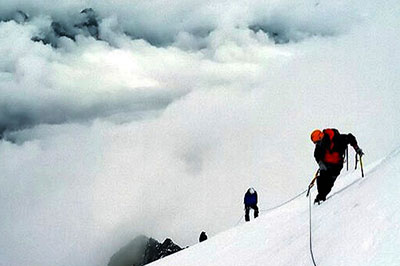
一)Once cold, once warm 低温损害和高原灼伤
The ambient temperature is lowered by 6.5 ° C every 1000 merters increase in altitude, so it's no wonder that the summit of Everest temperatures regularly fall below -40 °
海拔高度每升高1000米,环境温度下降6.5摄氏度。因此,在珠峰顶上气温周期性地降到低于零下40摄氏度是件毫不奇怪的事情。
Mountain climbing is extensive periods of intense boredom interrupted by occasional moments of panic fear.
登山活动是偶尔会被突发的恐慌打断的漫长无趣过程的组合体。
TEMPERATURE 温度
The ambient temperature is lowered by 6.5 ° C every 1000 feet increase in altitude., So it's no wonder that the summit of Everest temperatures regularly fall below -40 ° C. Under these conditions, there is a huge demand for calories, our bodies can avoid hypothermia (hypothermia - a fall in body core temperature below 35 ˚ C) only if they receive appropriate calorie diet. Protecting themselves against low temperatures, remember that the air insulates well, so several layers of clothing to protect against the cold better than one thick.
海拔高度每升高1000英尺(304.8米),环境温度下降6.5摄氏度。因此,在珠峰顶上气温周期性地降到低于零下40摄氏度是件毫不奇怪的事情。在这种情形下,身体需要大量的热量。只有在适当的含热量饮食前提下,我们的身体才可以避免体温过低(身体核心温度降低到35摄氏度以下)。为避免低温伤害,请确保有效地隔离空气。也因此,多层衣服御寒效果好过一件厚衣服。
Wind 风
The inquisitive might underestimate frost on Everest, giving counterexamples much lower temperatures recorded in the polar areas (the lowest temperature recorded on Earth is -89 ° C at the Russian Antarctic research station Vostok). But factor in deciding that, however, Everest and other peaks eightthousander are more inaccessible and dangerous for human health, is the wind. You do not need to go to the mountains high to learn this lesson. When we go for a walk in a winter Sunday, cold but windless morning, it is - provided that we are well dressed - even temperature of -30 ° C does not make a big impression on us. When this is accompanied by an aura of calm sunshine, but snow crackling under his feet tells us how low a temperature. But when the same temperature will be accompanied by a slight wind (16 km / h), the human body feels lowering the temperature to about -45 ° C! When the wind starts to even more eccentric (40 km / h), the subjective feeling cold becomes unbearable, in fact amounts to approximately -70 ° C!
由于极地录得的低温记录(地球上的低温记录由俄国南极Vostok考察站录得,零下89摄氏度),好奇的人们可能会因这个反例而低估珠峰上的冻伤。但是,尽管珠峰和其他八千米山峰更难以为人类所接近,然而对人类健康的危害的决定性因素是风。你并不需要攀到这个高度以学到这些。当我们在冬季一个寒冷但无风的周末散步时,由于服装适宜,即使气温低到零下30摄氏度,这样的天气也不会对身体有大的影响。尤其是有暖人的阳光时,只有脚踏在雪上的声音提醒我们气温是如何的低。在相同的环境温度下,但有微风(风速为16千米/小)时,身体感受到的温度接近零下45摄氏度左右。当风变得更大(40千米/小时),主观上感受到的寒冷将变得无法忍受,事实上,相当于零下70摄氏度左右。
Since the height of 7000-8000 m above sea level the air is much thinner than at sea level, hurricane blowing in the wind (eg, 150 km / h) has less power than the same wind at lower altitudes. The force with which the wind acts on the human or tent is lower, but its speed is still 150 km / h, which makes the crumbs kidnapped by the wind snow ice or iced smagają face with great force.
由于海拔7000到8000米的高度上空气比海平面稀薄,因此这个高度上的飓风(比如,风速为150千米/小时)的风力要低于低海拔地带。事实上,这样的高度上,风力对人体或帐篷的影响也比较小。但是风速依然为150千米/小时,这使那些被风卷起的碎屑,如击打到面部的冰雪等,依然具有很大的力量。
Frostbites 冻伤
Freezing of the skin in such cold air is able to prevent only an adequate number of warm blood. Meanwhile, the body, with limited stocks and the possibility of bringing warmth to any part of your body, warm blood starts to regulate. The first victims are the hands, feet, nose, ears. Why? Their ratio of surface area to volume is very large - the body is not "worth" is wasted on it's limited reserves. He devotes so these parts of the body to maintain warmth in the central (responsible for the most important functions of life) parts of the human body.
在如此寒冷的情况下,唯一能防止皮肤冻伤的是充足的温暖的血液。期间,储量有限的血液,和能把热量带到身体任何部位的人体开始自我调节。最先的牺牲品是受,足,鼻子,耳朵。原因在于,这些部位的表面积和体积的比率非常之高-身体不值得为此浪费有限的储备。身体竭尽全力维持人体中心部位的体温(这些部位保证人体维持生命过程中最重要的功能)
As we all know, the human body is composed of 80% water, which if frozen in the human body creates ice crystals. As a result, damage to the cells and platelets adhere to one another, which in turn leads to the formation of blockages of blood. Formed in the ischemic necrosis of the body.
正如我们所知,人体内水的含量为80%。如果人体发生冷冻,将产生冰晶。其结果是,细胞受损,血小板连接在一起,并导致血液堵塞的发生。形成人体缺血性坏死。
How to protect yourself from frostbite? Preferably through a proper dress. It must meet four basic functions:
那么,如何防止身体的冻伤?适当的穿衣。这样的服装必须满足4项基本功能。
• Protect against the wind - windproof materials: Gore Tex, Wind Stopper, Wind Block etc
防风—防风材料包括:Gore Tex, Wind Stopper, Wind Block 等
• Protect from moisture - avoid wool, which keeps moisture (but not for modern, with appropriate proportions of mixtures of wool with synthetics)
防湿—避免选用毛织品,毛织品能保持水分(但不包括现代的和人工材料适当混合的毛织品)
• Thermally well insulated - a good method is to dress the onion: the air between the layers of our clothes also thermally insulates
绝热—最好的着衣方法就像洋葱一样,衣服之间的隔层中的空气同样绝热。
• Does not hamper the movements, not to oppression - attire not interfere with climbing or be too tight, which hinders the free flow of blood between the body parts.
不妨碍运动,也不压迫身体—服装不应妨碍攀登,也不能太紧,太紧的衣服妨碍血液的自由流动。
But what to do once you have bit zmarzliśmy and we intend to restore the circulation in the frozen parts of the body? Well then come to the aid gel heaters that operate by way of a chemical reaction with air (oxygen). Give off heat for 10 hours and could reach a maximum temperature of 60 ° C.
但是,当感到寒冷(文中有几处出现波兰语单词,猜测意思如此。),我们试图恢复冻伤部位的血液循环时,该如何?借助于aid gel heater,一种和空气发生化学反应产生热量的胶体加热器。可以连续发热10小时,最高温度可达60摄氏度。
Sunlight / ultraviolet radiation
阳光/紫外辐射
Often, high mountains, such as the Himalayas, often associated with high frost, cold. It's true. However, in the high mountains as often occurs to burn! Sun damages even stronger in winter than in summer, and this in conjunction with dilution air at low temperatures, effects of the sun on the dry, fat-free natural skin protection. In addition, the sun reflected from the snow, "God gives us" UVA and UVB (snow reflects more than 80 percent of UVA and UVB rays!).
比如喜马拉雅山系之类的高山地带,通常和严寒和冻伤有关。确实如此,但是在这些地方,同样会发生灼伤。阳光在冬季造成的伤害比夏季更严重,这和低温状态的稀薄空气有关,还和干燥的无脂肪的护肤品有关。此外,还有积雪反射的阳光,也就是上帝给予我们的UVA(长波紫外线) 和UVB(短波紫外线)(雪可以反射超过80%的UVA和UVB辐射)
Permeability of UV radiation through the atmosphere increases by 4% at 300 meters above sea level. In the case of the high mountains of the radiation intensity increases, so tens of percent! Therefore, it is necessary to adequate protection from the sun:
在海拔高度300米时,紫外线穿过大气时,渗透率提高了4%(和海平面相比),在高海拔地带,渗透率的提升达到数十个百分比。因此,适当的防护是必须的。
• Creams - because the radiation is particularly strong, creams filter must be at least 40 We must especially remember the lubricant ears, chin, and paragraph
面霜—由于辐射强烈,面霜至少应过滤掉40%的辐射。尤其是不能忘记在耳朵,下巴,和颈部涂抹。
• Glasses - often underestimated part of the garment climber; glasses of poor quality can lead to snow blindness. Select sunglasses category 4 (European standard defines the eye in terms of light transmission - the number 4 means that the glasses block over 90% of the radiation). For greater expedition we should always have spare glasses!
太阳镜—这一点经常会被忽略。低品质的太阳镜能导致雪盲。选择sunglasses category 4(第四类太阳镜,欧标按照入射到眼睛的光线来定义—这类眼镜阻止超过90%的辐射)。对于大型探险活动来说,我们总是要携带备用眼镜。
• Goggles - serve as an alternative to glasses, especially important during the blizzard, snow zadymek. Like the glasses should have a fourth degree of light transmission.
护目镜——担任太阳镜的替代品。尤其在暴风雪中非常重要。选择标准同太阳镜。
• Dress - inappropriate (too thick) can dress in warm weather lead to heat stroke, which is the main cause of the imbalance in heat. As a result, overheating occurs, weakening or even loss of consciousness.
服装—不适当的服装(太厚)在温暖的天气里将导致中暑。主要原因在于热不平衡。结果是产生过热,导致虚弱甚至休克。
Text and photos: Martin Miotk
图文作者:Martin Miotk
"Mountains", No. 8 (147) 2006
from yatyat.
关于Martin Miotk,请YATYAT同学补充。
备注:文中有部分波兰语单词,据YATYAT同学所说,这些文章的原文是波兰语,因此翻译过程中,难免需要猜词,因此会产生理解上的偏差,欢迎读过原文的同学指正。下同。
 枫叶红了
·
2010-07-24 15:48
枫叶红了
·
2010-07-24 15:48
二)
Acclimation
适应高海拔
Each of us when suddenly the sea level would have been transported by helicopter to a height such as Mont Blanc (4,810 m) in a few minutes lost consciousness because of the small amounts of oxygen.
我们中的每一个人,当搭乘直升飞机从海平面到达高海拔地带,比如白朗峰(海拔4810米),会有几分钟的休克,原因在于哪里的空气含氧量低。
Each of us when suddenly the sea level would have been transported by helicopter to a height such as Mont Blanc (4,810 m) in a few minutes lost consciousness because of the small amounts of oxygen. But when we apply a process of gradual acclimatization, we are able to gain the summit safely, even in a few days. Acclimation is the process of steps taken to adapt the organism to the conditions prevailing at high altitudes.
我们中的每一个人,当搭乘直升飞机从海平面到达高海拔地带,比如白朗峰(海拔4810米),会有几分钟的休克,原因在于哪里的空气含氧量低。但是在经过渐进的适应过程后,我们甚至可以在几天时间内安全的登顶,适应过程就是一步步地让身体适应高海拔条件。
Decalogue proper acclimatization might look like this:
适宜的适应过程应该类似下列十条:
First we need to gain height gradually - then your body has time to adapt to a given height. Fairly trivial advice, but, unfortunately, often neglected by climbers and mountaineers. According to many of them acclimation time is time lost, which should shorten. In a situation when it gets just a few weeks' leave on an expedition to the Himalayas or a week on a trip to the Alps, there is a strong temptation to attack the wall without prior acclimatization. As a result, the pace of climbing falls, increases the risk of error, because man is more acclimated badly distracted.
首先,我们需要逐渐攀升—这样身体将有时间来适应给定的高度。这一条确实是老生常谈,但是不幸的是,它总被登山者忽略。对他们来说,花时间来适应等同于浪费时间,因而需要缩短。在只有几个星期的时间内在喜马拉雅山中探险,或一周的时间在阿尔卑斯山等情况下,不进行预先的适应,而直接攻顶。这样的想法非常具有诱惑力。其结果是,由于不能很好的适应环境,攀升的步伐缓慢,出错的风险增大。
Over the second 3,000 m Avoid road or air transport - on foot height gain. The cost of acquisition of zaprocentuje better moods during the acquisition of the next level. Of course, if our base is located in the Himalayas above 3,000 m and thus it is possible to reach there by car field, of course, use this, but access to the site must take place in several stages with the possibility of educational tours aklimatyzacyjnych.
第二,海拔三千米以上,避免搭乘车辆或飞机—徒步攀升。这样做的代价是在下个阶段的攀升中,对困难的预估不足。当然,如果是在喜马拉雅山,大本营设定在海拔3000米以上,因此有搭车前往可能的。但是这个过程必须分成几个阶段,并且在有经验的人士指导下进行。
Third best remedy for problems with acclimation is a descent to lower altitude. When you feel symptoms of high mountains, it means that we are on the border between our level of acclimatization. We must then spend the night at this altitude, or go down.
第三 和适应有关的问题的最佳解决方法是下降到低海拔处。 当感觉到高山病症状时,意味着我们已经处于适应环境的临界点了。我们必须在这一高度上过夜或下到低处。
4 th"Climb high, sleep low" - iron maxim climbers. This principle is realized in the subsequent establishment of the mountain camps, for example, while in the first camp (5700 m above sea level) has not climb directly onto the bed to the second camp (6400 m), but pitched a tent there, leave the gas, food and go to sleep to the camp first. The next day we head for the first night of the camp to another. Why such a combination? While temporarily in the second camp, the body "gets a signal" about the need to adapt to a higher altitude and at night went to the camp first started like crazy to produce red blood cells, because it feels "that it can be useful in the near future." And useful - when the next day we will sleep in the second camp, we will instantly feel much better than the first visit. This same technique we use when setting up higher camps.
第四 高处攀升,低处过夜 —对攀登者而言,这是铁的定律。这个原则也在(大本营)之后的高山营地建立过程中得到体现。例如,从第一营地(海拔5700米)爬到第二营地(海拔6400米)后,不会直接在这里休息,但会把气体,食物留在在这里扎好的帐篷里,然后返回第一营地睡觉。接下来的第二天,再返回第一天扎好的营地,然后再到下一个。为什么是这样的一个组合?当在第二营地临时停留时,身体“接收到需要适应一个比较高的海拔高度的信号,当晚上返回第一营地时,身体开始迅速制造红细胞,因为身体认为这样做在不远的将来时有用的。”确实如此,当第二天,我们在第二营地睡觉时,我们将感到比第一次到达这里时舒适的多。当我们建造较高的营地时候也使用同样的技巧
5th fluids, fluids, fluids. At high altitude we have a lot to drink, because the process of acclimation is accompanied by a significant loss of water. It is understood that in order to prevent dehydration of the body, must take a minimum of 3-4 liters of fluid a day. Best when they are isotonic fluids (to make up the body washed vitamins and minerals) and / or sweet fluids (to supplement the body with glucose).
第五是补充液体,补充液体,还是补充液体。由于适应过程中伴随着相当数量的失水,在高海拔地带,我们需要饮用大量的水分。为了防止身体脱水,每天最少需要饮用3到4公升饮料。这些饮品最好是等渗等压型饮料(以补充身体流失的维生素和矿物质)以及/或含糖饮料(补充身体需要的葡萄糖)
Make a small sixth physical activity during their stay at higher altitudes (securing the tent, the security for the melting of snow or even a slight "foot" ) - it is preferable to property lying in a tent or sleep, because it reduces oxygen demand, which may exacerbate symptoms alpine .
第六 停留在高海拔处时,做些轻微的体力活动(比如查看帐篷,消除融雪带来的威胁,甚至紧固松动的锚脚)-最好躺在帐篷里休息或在里面睡觉,这样可以减少了可能使高山症状加剧的需氧量增加。(或者是在高海拔处停留时,轻微活动比躺在帐篷里休息或睡眠更好?)
7th Avoid tobacco, alcohol, or even of sleeping at high altitude - will consume an additional weakening of the body.
第七 避免吸烟,饮酒,甚至在高海拔睡觉—这将进一步消耗已经虚弱的身体。
8th Food that we eat must be rich in carbohydrates (energy building blocks), because high-altitude climbing causes a significant loss of strength. It should go on a trip with a slight overweight - accumulated fat is an excellent fuel, spare, because they contain more energy than carbohydrates. The potential reservoir of energy stored in adipose tissue is a man thirty years about 100 thousand. calories - which is sufficient to overcome ... some 17 thousand. km! So to move a distance equal to almost half of the equator. It looks very poorly at the energy accumulated in the form of carbohydrates, which we barely have enough for about six hours long walk.
第八 食物必须富含碳水化合物(能量的主要来源)因为高海拔活动引起体力的重大损失。在进行这样的活动时应该略微超重-逐渐积累起来的脂肪是极好的备用能量来源,因为它比碳水化合物储备的能量更多。在脂肪组织中储备的潜在能量有可能达到10万卡路里(一个男人花费三十年时间储备下来的能量),这些能量足以完成17000公里。相当于绕赤道半圈。我们勉强吃下的碳水化合物中积累的能量就少得可怜,只能满足我们6个小时的行走。(这一段的翻译,我自己也无法忍受,大概意思应该如此了。欢迎读过原文的同学指正)
Rest 9th (of English break) - we can not climb all the time, we also need to rest - give your body time to rejuvenate, adaptation to altitude. It is understood that after every three days of intense activity climbing should be two days of rest in the database. But often the weather dictates periods of rest and it happens that waiting for the weather to improve, we spend even a week in the database. Then, however, rested, regenerated and hungry climbers set off with enthusiasm to earn more of our climbing feet.
第九休息—我们不可能总是在攀登,我们同样需要休息—让身体有时间复原,适应给定高度。每三天高强度的攀登后,应有两天在大本营休息。然而气候常常给出休息时期,同样在等待天气变好之前,也在休息。我们甚至会在大本营停留一周时间。然后,休息好的,身体复原的以及渴望攀升的登山者们满怀热望出发,以在高处留下更多的足迹。
10th team - people aklimatyzują at different rates, so before we will continue to climb further, make sure that our entire team is well acclimated.
第十 团队 人们的适应速率不同,因此在我们继续向前方攀爬前,应确保全体人员都已经很好完成适应过程。
Personally, before each expedition (about 1-2 weeks), I try to go in the medium mountains (preferably the Alps, but also the Tatras), to spend one or two nights at higher altitude. Even spending two nights in the High Tatras hostels above 2000 m above sea level provides important information for the body to reside in a higher height. As programmed, the body begins to slowly prepare for the height, slowly producing red blood cells.
在每次远行之前(约1到2周),我自己会前往中等高度的山区(阿尔卑斯或塔特拉斯山,后者更好),在那个高度上停留一到两个晚上。即使是在海拔2000米的高塔特拉山旅馆停留两个晚上,也能给身体以重要的信息,以便重返高山。程序化地,身体开始缓慢地为等高做准备,慢慢地开始制造红细胞。
Often the question arises as to how long we have enough acclimation? In other words, how soon after the expedition / climbing lose acclimatization (adaptation to high)? Does our body, a month after the end of the expedition, is able to once again safely reach the previous level? As with the acquisition of acclimation depends on individual predisposition. It is understood, however, that the loss of acclimatization time equal to time of acquisition. So if we were on an expedition to Pik Lenin, which lasted three weeks, after twenty-one days of completion must be assumed that acclimatization already "lost." But for rock climbers, who often ride in the high mountains, beaten acclimatization process is slower.
时常有这样的问题浮现,我们需要多久才能完全适应?换句话说,探险/攀登过程结束后,多长时间后身体对高海拔的适应改变复原?结束远行后,在一个月内身体是否可以安全地恢复探险前的状态?由于适应能力的获得依赖于个体的体质,因此,适应高海拔的身体改变的消失和获得这些改变需要的时间相等。这个是可以被理解的。那么,如果在Pik Lenin,的探险持续了三周,那么在完成探险之后可能需要21天时间来消除身体为适应高海拔环境的改变。然而对于登山者来说,由于他们经常在高海拔地带活动,这个过程的进行要更为缓慢一些。
REMEMBER THAT YOU SHOULD
你应该牢记下面这些
During the collapse of weather reduced atmospheric pressure - everyone knows that a meteorologist, but not only. Older people often feel bad when bad weather, storm, snow / rain.
恶劣的天气导致气压降低—人人知道天气预报,但是不止于此。在糟糕的天气中,年龄较大的人经常感觉不好。比如风暴,降雪降雨。
In winter, the atmospheric pressure is lower than in summer at the same height - in the summer when the temperature rises, increasing the atmospheric pressure, with the result that the air contains more oxygen. In the winter, but a lower concentration of oxygen, the situation worsen severe weather conditions: hurricane winds and larger ice walls / mountains - which the participants could experience such a winter expedition to K2. Only a few managed to go so far on Everest without oxygen, in the winter so far there has only one entrance with no oxygen. This remarkable feat made in 1987, Ang Rita Sherpa.
相同海拔的情况下,冬季的大气压低于夏季——夏季由于气温上升,大气压力升高,结果空气中的含氧量也增加。 在冬季,除了空气中含氧量降低,使情况变糟的恶劣天气状况还有强风以及结冰的峭壁和山峰—在K2的冬季里参加过探险活动的攀登者能体会到这点。迄今为止,只有少数人设法在无氧状态下攀登珠峰,而在冬季的珠峰只有一人无氧攀登过珠峰。这项创举在1987年由Ang Rita Sherpa完成。
The higher the latitude, the lower the atmospheric pressure at the same height - if Mount Everest lies on one of the poles, the pressure would be there, too low to climb without oxygen. It is also noteworthy that the highest peak, starting from the center of the earth is not Everest, and lying near the equator peak Chimborazo (6,310 m)
相同海拔地带,纬度越高,大气压越低—如果珠峰位于南北两极的任一极地,其上的大气压将低到人们无法再无氧状态下攀登。值得注意的是,从地球中心开始计算,最高峰并不是珠峰,而是赤道附近的peak Chimborazo (6,310 m,位于厄瓜多尔)
Aircraft - passenger jets, which typically fly at an altitude of about 10 000 m above sea level, is kept artificially atmospheric pressure. But this is not the sea level pressure, only pressure corresponding to a height of about 1500 - 2500 m above sea level Maintaining a lower level and thus the greater the pressure difference between inside the cab and the environment would increase significantly the weight of the aircraft and, consequently, the cost of the flight. The persistence of that amount and consequently the partial pressure of oxygen is sufficient for the human body. However, the elderly or suffering from heart disease can feel undermined. Characteristic "twinges in my ears" when landing an airplane is nothing but increasing the pressure inside the cabin to the pressure prevailing in the Earth's surface. During take-off aircraft, we reverse phenomenon - lowering the pressure.
航空器—飞行在万米高空的客机,内部的大气压是人为保持的。但其数值并不等于海平面大气压,而是相当于海拔1500米到2500米左右的大气压。之所以保持这样低的压力是由于,机舱内外的大气压差越大,航空器的重量也要相应增大,其结果是飞行的成本增大。保持这样的气压值还因为在这个压力值下,氧气的分压力完全可以满足人体的要求。但是,老年人或患有心脏病的病人会感到不适。在客机着陆时典型的耳痛(突然发作的耳膜刺痛)只是由于机舱在加压到地表大气压值。在客机起飞过程中,人们体验到的反向现象则是由于客舱在降压。
Thermometer - it should be remembered that in the high mountains without taking the mercury thermometer, because it freezes at - 39 ° C. At very low temperatures using a thermometer alcohol.
温度计—请牢记在高海拔地带不能用水银温度计,因为汞的冰点是零下39摄氏度。在低温环境中使用的温度计是酒精温度计。
Martin Miotk (Bergson Team www.bergson.pl , www.miotk.pl )
Tops No. 6 (145) 2006
2006-10-03
枫叶红了
·
2010-07-24 15:49
三)Disease alpine 高山病
The summer period is a time of holidays in the high mountains of Mount Blanc, starting and finishing at Himalayas. For many this will be the first meeting with heights greater than the Tatra Mountains, to the other - new records of the Pamirs and the Caucasus
从喜马拉雅开始和结束的夏季意味着人们要在勃朗峰度假。对许多人而言,这将是他们首次踏足海拔高于Tatra Mountains(塔特拉山脉,位于捷克北部与波兰南部)的高山地带,而对另外一些人而言,则是在帕米尔高原或高加索山上谱写新记录的好时机。
There are only three real sports: bullfighting, car racing, and mountaineering. All other games are just ... 真正的体育项目只有三项:斗牛,赛车,登山。至于其他项目嘛,嘿嘿。.. ..
—Ernest Hemingway (欧内斯特•海明威,老人与海的作者)
The summer period is a time of holidays in the high mountains of Mount Blanc, starting and finishing at Himalayas. For many this will be the first meeting with heights greater than the Tatra Mountains, to the other - new records of the Pamirs or the Caucasus. High mountains often infect us with its beauty, and the unavailability of severity, are associated with many challenges and dangers. In the first episode of our series Miotk Martin, author of the first Polish entry without oxygen on Everest, will discuss issues related to high altitude sickness.
从喜马拉雅开始和结束的夏季意味着人们要在勃朗峰度假。对许多人而言,这将是他们首次踏足海拔高于Tatra Mountains(塔特拉山脉,位于捷克北部与波兰南部)的高山地带,而对另外一些人而言,则是在帕米尔高原或高加索山上谱写新记录的好时机。高山之魅无可阻挡,其不可亲近总是和危险和挑战密切相关。在首位无氧攀登珠峰的波兰人Miotk Martin执笔的系列文章中,开篇之作就是讨论和高山病有关的话题。
AND YET YOU CAN 相信你自己
Alpine disease (called Acute Mountain Sickness - AMS) has been known for thousands of years. For the ancients, was a great mystery - they argued that the guilty are the gods who come down on people crazy. Greeks, reeling from exhaustion at the top of Mount Olympus (2,917 m), believed that it is reserved for the Gods. But that does not climbers initially brought the greatest contribution to a better understanding of the impact on human health. Better understanding of this phenomenon is due baloniarzom who are already in the mid-nineteenth century they built a balloon to a height of about 10 000 meters before he took over the baton to climbers. Thanks to the British exploration of Mount Everest already in the twenties of the last century it was known that a person can spend a few days at an altitude of about 8000 meters, provided that it will progressively be aklimatyzował. Above 8000 m necessitate the use of artificial oxygen seemed inevitable. However, initially an opponent of the use of artificial oxygen was even a famous Briton George Leigh Mallory - he considered such facilities to be unsportsmanlike. Only two unsuccessful expeditions in 1921 and 1922 years Mallory convinced that without artificial oxygen will never take up his dream and as a result during his last expedition in 1924, he began to use oxygen support. Also, John Hunt, leader of the first victorious expedition to Everest in 1953, said that if no additional oxygen, which they used the first conqueror Edmund Hillary and Tenzing Norgay, the expedition will not dotarłaby to the top. The need to use oxygen during the climb to the summit also confirmed that expedition physiologist Dr Griffith Pugh, according to which "only exceptional people can go to over 8,200 meters without supplementary oxygen." Only in 1978, Peter Habeler and Reinhold Messner proved that you can enter the Earth's highest mountain without supplemental oxygen. Entries made from Nepal, by the classic South Pass. Some commentators have called this feat first real entrance to the Mount Everest. Szerpowie but they could not believe that this is somehow outside the arrivals of Nepal are capable of such a feat which has not yet been able to make any tubylcowi. After quietly questioned whether the achievement of the Europeans, accusing them of using miniature oxygen cylinders. The charges, however, were not confirmed. Messner in 1980 silenced all the doubters by making the first solo entry without the use of oxygen - this time from the Tibetan side. Currently, the entry without oxygen on Everest are rarely - every year it goes to only a few hundred people on the winners, who come from the oxygen.
Alpine disease (called Acute Mountain Sickness 简写为AMS,也被称为严重的高山反应)在数千年前就为人所知。对古人而言,这是件非常神秘的事情,他们认为这是众神的惩罚。在Mount Olympus(奥林匹斯山,海拔1917米)山顶痛感精疲力尽的古希腊人确信这座神山是众神的所在。然而,最早搞清楚这种现象对人类健康的影响,并做出重要贡献的人不是登山者。而是19世纪中叶的气球爱好者。在把研究这一现象的接力棒交给登山者之前,他们建造的气球升到了10000米高空。应该感谢上个世纪20年代的英国人对珠峰的探险。这表明人们可以在经历渐进的适应过程之后,可以在海拔高度高于8000米的地方停留数日。在八千米以上的高度上,似乎人造氧气的使用是必不可少的。虽然起初反对使用人造氧气的就是当时英国著名的George Leigh Mallory(英国在1920年代三次探险珠峰的参加者,登山家,1924年6月在英国人第三次冲顶珠峰时遇难,遗体于1999年在珠峰北坡被发现,和他一起遇难的还有另一位登山者,也是他的队友Andrew Irvine 见:http://www.everest1953.co.uk/MalloryIrvine.php),他认为这么做有违体育道德。只是在经历了1921年和1922年的两次珠峰探险失败后,Mallory才确信,如果不使用人造氧气,他的登顶梦想将永远无法实现。于是在1924年他的最后一次探险中,他才开始吸氧。同样,在1953年首次带队成功登顶珠峰的领队John Hunt也说,如果没有使用氧气,他们的队将无法到顶。同样如果没有用氧,Edmund Hillary 和 Tenzing Norgay也不能成为珠峰的首位登顶者(http://imagingeverest.rgs.org/Concepts/Imaging_Everest/-75.html)。登顶过程中使用人工氧气证实了随队探险的生理学家Griffith Pugh博士(1953年英国攀登珠峰的探险队的随队人员之一,http://www.ncbi.nlm.nih.gov/pubmed/12006169)所说(记述)“只有非凡的人才可以在海拔8200米以上不用补充氧气”。直到1978年,Peter Habeler 和Reinhold Messner(http://www.pbs.org/wgbh/nova/everest/history/firstwoo2.html)从尼泊尔一侧经典的珠峰南部通道登顶之后,才证实人类可以不用吸氧而登顶世界最高峰。有部分评论员称这一创举是人类真正意义上的踏足珠峰。Szerpowie (夏尔巴人)无疑可以做到。但是有人无法相信,除去尼泊尔人之外,居然还有人能用这种方式(无氧攀登)完成这种从未有过的创举。在对欧洲人的这项成就充满怀疑的论调中,有人假设这两人使用了微型氧气罐。当然,这种猜测从未得到证实。Messner在1990年单人独自无氧登顶珠峰让所有的质疑者安静下来—这一次,他从西藏一侧出发。直到今天,无氧登顶珠峰的仍然凤毛麟角-每年有几百人成功登顶,但都有使用氧气。
RESEARCH CORNER 相关资料
For a better understanding of the impact on human health is needed short lesson on the borderline of physics, chemistry and medicine:
为了更好地理解高反对人体的影响,下面列出一些基本的物理学,化学,医学常识。
Torricelli first: Air has weight.
首先是托里拆利:(他证明了)空气是有重量的
Pascal second: Because air density decreases with increasing altitude, atmospheric pressure decreases with ascent.
然后是帕斯卡:由于空气密度随着海拔高度的升高而下降,因此大气压力随海拔高度的上升而下降。
The third sea level atmospheric pressure is 760 milliliters of mercury (mm Hg).
第三点:海平面大气压是760毫米汞柱。
4th adult person at rest uses about one-third of a liter of oxygen per minute. During intense exercise, with which we face while climbing Everest for example, demand is increasing more than tenfold.
第四点:成年人在休息时,每分钟耗氧量为约1/3升。在激烈的运动中,例如攀登珠峰的时候,这个数值将增大到远远超过10倍。
Fifth oxygen is 21 percent air, carbon dioxide, 0.04 percent, the rest is mostly nitrogen.
第五点:空气中,含21%氧气,0.04%二氧化碳,其余大部分为氮气。
At the sixth summit of Everest the air contains the same percentage of oxygen, but because the atmospheric pressure drops to 30% that of sea level, the partial pressure of oxygen in air is reduced proportionately - in other words, the harder your body absorbs oxygen.
第六点:珠峰峰顶的空气组分和其他地方一样,但是由于那里的大气压下降到海平面的30%,所以氧气的分压力也同比例下降—换句话说,人体吸入氧气的难度增大了。
7th to the large body of well-dotlenić begin to breathe rapidly. This additional ventilation raises blood oxygen content, but never such as that at sea level. Hypoxia caused by an organism called high altitude hypoxia.
第七点:由于大量的氧气被快速吸入,呼吸量的额外增大使得血液中的氧含量增大,但是绝对达不到海平面数值。因此在机体内产生的低氧被称作高空缺氧。
8th regulator breathing carbon dioxide is produced in the body as an unnecessary product of metabolism. Blood carries carbon dioxide to the lungs, where it is expelled outside. The faster you breathe, the more carbon dioxide exhaled and the partial pressure in the lungs is reduced, so is more space for oxygen.
第八点:机体调节 呼出的二氧化碳是身体新陈代谢中产生的无用产品。血液把二氧化碳运送到肺脏,在哪里二氧化碳被排出体外。呼吸频率越快,呼出的二氧化碳越多,肺内压力因此下降,也因此为氧气留下更多空间。
9th body reacted to the large amount of reducing oxygen in the blood, which in turn stimulates the kidneys to produce erythropoietin - the hormone that stimulates the bone marrow to produce red blood cells (erythrocytes) contain hemoglobin, a higher concentration in the blood increases significantly the transport of oxygen to the body .
第九点:身体对血液中含氧量的下降的反应是刺激肾脏产生红细胞生成素—刺激脊髓产生红细胞的激素,erythrocytes(红细胞)中包含有血红蛋白,血液中血红蛋白浓度的升高可以显著地提高血液输送氧气的能力。
10th More red blood cells, however, increases blood viscosity, which hinders the work of the heart. This explains why, born at high altitude (eg Szerpowie) have more heart to pump blood efficiently. Their lungs and tissues have more capillaries, which greatly facilitates the uptake and transport of oxygen.
第十点:红细胞的增加,将增大血液粘度,这使得心脏机能下降。这个现象可以用来解释,出生在高海拔的人群,例如夏尔巴人,他们拥有强壮的心脏。他们的肺部和身体组织中拥有更多的毛细血管,这使得他们的身体摄取以及输送氧气的能力显著提高。
Mountain DISEASE - WHERE IS THE BORDER? 高山病的临界点
At what level we begin to feel the effects of high mountain sickness? In humans, who inhabit the lowlands first symptoms appear on a mountain higher than 3,000 meters. However, this is largely an individual matter. Some have already felt the amount during the stay of the Sea Caught (1500 m) - not really knowing unless the matter, from which they feel uncomfortable. Oft-repeated theory is that there is the phenomenon of "memory altitude" - it means that a man who at least once in a lifetime spent at a given height (eg, 4000 m above sea level), it will feel better at this altitude, where for example a year or two to reach that height again - of course, compared to a novice at this altitude. At an altitude of 5000-7800 m altitude acclimatization already runs very slowly, and reduced physical fitness. 7800 m above the height of entering a "death zone" - here is the sharp decrease of physical strength, regeneration of the organism is not possible. Decreases body weight, body not only burns excess fat, but also uses proteins in muscles. Period of stay at that level should be limited to a maximum of 2-3 days.
海拔高度达到那个数值时人们开始感觉到高反症状?对于生活在低海拔地域的人来说,海拔高度超过3000米时,开始出现高反的初步症状。然而,在很大程度上取决于具体的个体。在海拔1500米的高度上,也会有人发生高反症状—目前还不清楚是什么原因导致他们感觉到不舒服。时下流行的理论认为人体对海拔高度有记忆效应-这意味着,如果一个人曾经在一个给定的海拔高度(例如海拔4000米以上)呆过一段时间,那么和初次涉足这个高度的人相比,当他在一年或两年的时间范围内,再次来到这个高度时感觉会好很多。在5000米到7800米的海拔高度上,高原适应的过程会变得非常缓慢,同时身体的适应性也在降低。7800米以上,就是死亡地带—在这个高度以上,体力急剧下降,发生的机体受损几乎是不可逆转。体重下降,不仅体内脂肪被过度消耗,而且肌肉组织中的蛋白也被氧化。在这个高度停留的时间应该被限制在不超过2~3天。
At high altitude there is a gradual loss of the so-called. ceiling of oxygen (VO2max), which is the maximum capacity to absorb oxygen through the body. VO2max decline observed since small amount (about 1400-1600 m above sea level), then follow it as far as linear: about 11% for each 1000 m increase in height. At the height of peaks ośmiotysięcznych VO2max is only about 20% of the value of sea level.
在高海拔地域,会发生所谓的VO2max氧上限,也就是说身体吸收氧气的最大能力的逐步衰减。VO2max的下降在低海拔高度(海拔1400米到1600米)上就会被观察到,然后呈线性下降:每升高1000米VO2max下降11个百分点。在ośmiotysięcznych峰顶,VO2max值只有海平面的20%。
SYMPTOMS 症状
The pace gets used to the height is a feature of an individual. There is no single limit (height) on which there are symptoms of altitude sickness. However, as these symptoms be recognized? Here are the most common of them:
出现高山病症状的海拔高度取决于个体,没有一个统一的海拔高度,在这个高度以上,高山病症状出现。然而,当下列这些常见症状被确认时,(就可以确定是出现高反了)
First pain / vertigo - the most common symptom.
首先是疼痛/眩晕—这是最常见的症状。
Insomnia second - if there is a long time, especially bad for recuperation.
其次是失眠—如果发生很长时间,尤其是很难消失
3rd No appetite.
第三是没有食欲。
4th Irritation / irritability.
第四是烦躁/易怒
5th muscle pain.
第五是肌肉疼痛
6th General fatigue.
第六是全身疲劳
7th Nausea / dementia - apathy, lack of view, the approach on the principle of "all one to me."
第七是恶心/痴呆—表情冷漠,眼睛无神,对任何事情都漠不关心。
8th Vomiting - a typical reaction to a significant body hypoxia.
第八 呕吐—这是身体对低氧的典型反应。
9th Swelling of the face, hands, feet - a very clear symptom of the disease, easily recognized by his swollen face or fingers of the hands.
第九是面部,手足的肿胀—高反的最明显症状,很容易通过患者肿胀的面部和手指来得出结论。
10th Problems with urination - a very characteristic symptom is often due to pulmonary edema.
第十 排尿困难—一种常和肺水肿有关的典型症状。
During the expedition we have very good to watch your partner / partners: how they behave, or urinate, or they are not swollen. Sometimes a sick person is hard to admit that something's wrong, it is passive and does not want to share the mountain.
在(高山)探险过程中,我们必须很好地观察我们的队友:他们的行为或小便情况,或他们是否肿胀。有时候,病人很难承认有些事情变得糟糕。他们总是被动的,在高山上更是如此。
CONSEQUENCES OF ILLNESS heights
高反的后果
Pulmonary edema (in literature called abbreviation Hape Altitiude Pulmonary Edema High) - a high-altitude pulmonary blood vessels to constrict. The problem is that some of the more narrow than others, making it by the other, unobstructed blood vessels, more blood flows, leading to increased blood pressure in the lungs. This can be compared to a partially clogged shower - by Way hole water comes out of the greater impetus (pressure). This increased pressure causes the bubbles leaked from pulmonary, accumulates fluid in them, which interferes with gas exchange. There are difficulties in breathing, literally filling the chlupocze fluid in the lungs, which can be heard clearly. As a result, the man suffocated, as breathing becomes impossible. Sick person coughs, no shortness of breath, is a sleepy, suffer chest pains. Sick, you need to quickly bring down the oxygen (or put in the bag pressure), and appropriate medications.
肺水肿(医学文献中,high altitude pulmonary edema缩写为HAPE,也就是高山肺水肿)在高海拔地带,肺部血管被压缩引起。由于部分血管变窄,迫使血液流向相对宽的血管,从而导致肺部血管血压升高。这种现象类似于部分孔洞被阻塞的淋浴头,其余水流通畅的出水位置处,水压升高。肺部血压升高导致泡沫出现,并在肺部累积妨碍气体交换的体液,并引起呼吸困难,肺内体液发出的声音可以很清楚的听到。结果,因呼吸困难导致窒息。病人不停的咳嗽,呼吸短促,嗜睡,并感到胸痛。此时,需要下降到低海拔地带,供给氧气(或放入高压氧舱),同时给予适当的治疗。
Cerebral edema (Hare High Altitiude Cerebral Edema) - niedotlenionych fluid from blood vessels in the brain passes out. Arises swelling, which increases the pressure inside the skull. Motor skills and mental patients deteriorate rapidly, leading to a coma followed by death. This disease is very dangerous because the patient may not notice symptoms, which appear almost without warning. As with pulmonary edema, the best remedy is to fast transport a patient down.
脑水肿(High Altitude Cerebral Edema,缩写为HACE,高海拔脑水肿)脑血管渗透引起。脑部肿胀,颅压升高。病人的运动能力和精神智力急剧下降,发生休克甚至死亡。由于病人可能未注意到这些症状,而极端地危险。这些症状的出现几乎没有任何预兆。对HACE病人来说,最好的治疗手段就是迅速把病人运送到低海拔地带。
CONSEQUENCES hypoxia
低氧症的后果
The effect of another human being - the very high altitudes (usually above 7000 m asl) to climbers due to hypoxia experienced by the impression that someone accompany them while climbing, climbing with them. Symptom of this feeling is common to watch behind him, waiting for someone or even reported in the literature, spilling tea into two cups. This effect could observe during their entry into the Everest - it is not dangerous, I almost feel that someone cares about me, someone watching over me.
对人体的影响—在极高的海拔高度(通常高于海拔7000米),攀登者由于缺氧,产生错觉,他们感到在他们攀登的时候,有人和他们一起(事实上没有)。类似的常见错觉还有有人在后面观察自己,或在等待某人,有文字记录的还有,同时把茶倒入两个杯子。这种影响在进入珠峰的时候可以被观察得到—但这并不危险,我感觉到有人在关心我,还有人在我头顶注视着我。
Fever peak (called summit fever) - to climb in the Himalayas must have extensive experience mountain motivations. However, the boundary between reason and morbid desire to enter the summit is very thin - especially when we think about it at the height of 8500 m for example, large amount of results that numb our brain is not receiving any incentives. Visible in the distance, the summit deludes us with its proximity. Reading the literature of the mountain, often do not give faith to be able to turn back 100 meters before the summit. After all, it's nonsense - we think. It seems that the 100 meters that's a few dozen minutes. Experienced climbers know, however, that it may take up to two or three hours - that would later decide on a safe return.
峰顶过热症(狂热地追求登顶)—在喜马拉雅山系里行走的人一定有他自己的登山动机。然而,在理性地登顶和病态地渴求冲顶之间的地带却是如此的狭窄—尤其是当我们置身于8500米的高度上时,各种各样的结果都可能发生。然而我们的大脑却接收不到任何刺激。顶峰在可视范围之内,登顶的欲望诱惑着我们。在可见的登山文献中,很难寻到能给我们强烈的信念让我们在距离顶峰100米时选择撤下。毕竟这么做,对我们来说太过荒谬。似乎100米只是几十分钟内可以完成的距离。然而,有经验的登山者知道,这段距离可能需要两个小时,甚至三个小时。而这段宝贵的时间往往可以决定我们是否可以安全的回来。
Medication 药物或治疗
Medicine dealing with doctors, not climbers, including medications given below are indicative only. Before the expedition should go to the doctor for prescribing the appropriate medications. Please also note that drugs that help one could harm another person (allergies, allergies, etc.).
这涉及医学专业,咨询医生,而不是登山者。下面给出的建议也只具象征意义。在开始准备出发登山之前,让医生给出适宜的药物。请牢记,对某一个人有效的药物可能是另一个人的毒药(比如过敏等)。
On just an ordinary headache pain reliever, such as Ibupron. However, do not over do it. Some also use aspirin, but generally it is not recommended because it diluted the blood and if bleeding is difficult to stem the blood. If you already use aspirin - the best half a tablet.
仅仅是一种常见的缓解头痛的药物,比如布洛芬,也不能使用过量。有人喜欢用阿司匹林,但是,一般不推荐这种药物,因为这种药物可以稀释血液,如果因伤导致出血,将导致很难止血。如果你习惯使用阿司匹林,那么最好减半。
Diamox or Duramid - acting diuretic drugs, often used to accelerate acclimatization, mostly well in the early stages of acclimatization.
乙酰唑胺—利尿药,常用来加快适应过程,主要用在高山适应的早期阶段。
OTHER USEFUL 其他有用的东西
Gamow bag - a bag pressure applied to the rescue of persons with acute symptoms of the disease mountains. The patient was placed in a special bag, which is then pumped in this way, the pressure in its interior symulowało lower altitude. A particularly useful tool in mountainous regions, where it is difficult to bring the patient to a lower height (eg Tibet).
便携式加压舱—压力袋,可以用来拯救患有急性高反的患者。病人被放置到袋内,然后加压,其内部压力可以模拟低海拔大气压。这是一种在高山地带非常有用的装置,在哪里,很难把病人带到低海拔地带(比如在西藏)
Pulsoximeter - a device for measuring the oxygen content in blood, allows you to measure the degree of acclimatization.
Pulsoximeter(血氧饱和度测试仪)一种测量血液中氧浓度的仪器,可以使你了解自己的适应程度。
Text and photos: Martin Miotk
图文作者:Martin Miotk
"Mountains", No. 5 (144), May 2006
原文为波兰语:
http://www.goryonline.com/gory,1354,170,0,1,F,news.html
枫叶红了
·
2010-07-29 16:35
文章基本完工,欢迎批评指正,如有转载,请注明,译文中文版首发磨房。谢谢。
Marcin Miotk 出身攀岩运动员,是 波兰攀山协会 国家攀岩队成员。近年兴趣兼及高寒攀登,05年成为 波兰 至今唯一 以无氧方式(亦无背夫、无高山协作)登上 珠峰 的人。 07年成功登上 俄罗斯 境内所有5座7000米级山峰,获颁雪豹称号。 08年起 担任 波兰 (规模最大成立于1927年) 华沙登山协会之会长。 Marcin 目前正与 kinga等 波兰队友 在攀登 K2。 高山适应(Aklimatyzacja, Acclimation)、高山病(Choroba wysokogórska, Disease alpine)及 高寒温度(Temperatura, Once cold, once warm) 原是他06年写的文章,深入浅出,很有参考的价值。他在目前个人 K2 的网页里也有贴出来:
http://www.miotk.pl/index.php?option=com_content&view=article&id=25&Itemid=12&lang=en 。
谢谢 枫叶 的精彩翻译,辛苦了!
原文有点奇怪,每下降6度,对应的应该是上升1000米,而不是1000 feet。
http://www.goryonline.com/gory,1500,170,0,1,F,news.html
看这里,你的说法应该是对的。
谢谢提醒,已经修正。
本文结尾的:
从尼泊尔一侧经典的珠峰南部通道登顶之后,才证实人类可以不用吸氧而登顶世界最高峰。有部分评论员称这一创举是人类真正意义上的踏足珠峰。Szerpowie (夏尔巴人)无疑可以做到。但是有人无法相信,除去尼泊尔人之外,居然还有人能用这种方式(无氧攀登)完成这种从未有过的创举。在对欧洲人的这项成就充满怀疑的论调中,有人假设这两人使用了微型氧气罐。当然,这种猜测从未得到证实。Messner在1990年单人独自无氧登顶珠峰让所有的质疑者安静下来—这一次,他从西藏一侧出发。直到今天,无氧登顶珠峰的仍然凤毛麟角-每年有几百人成功登顶,但都有使用氧气。
多少有点鼓励无氧登顶的意思,那么人类什么时候才能“真正意义上的踏足太空”呢? 和自然规律死磕,真的这么值得赞赏吗?
我倒不这么看,即使是在非夏尔巴人的其他人种中也有体质禀赋异于常人的。
比如14块游泳项目奥运金牌记录保持者,美国人菲利普斯。
再者说,作为无氧方式登顶珠峰为数不多的几人之一,波兰人在文章中多些几句,我也不认为有什么原则性的谬误。
何况他的大段文章是在写高山病,高山适应,而他自己强调最多的是高山适应,而不是让高山适应人。
比如他还这么写到:在每次远行之前(约1到2周),我自己会前往中等高度的山区(阿尔卑斯或塔特拉斯山,后者更好),在那个高度上停留一到两个晚上。即使是在海拔2000米的高塔特拉山旅馆停留两个晚上,也能给身体以重要的信息,以便重返高山。程序化地,身体开始缓慢地为登高做准备,慢慢地开始制造红细胞。
好帖
影响很大一个人,他们有欧洲人的特有气质,做的东西也是如此。
http://www.360doc.com.product.screwist.com/goods.php?sports-all
非常有帮助~