

The Leica Digilux 2 (wealthy cousin of the Panasonic DMC-LC1) is an interesting mix of analog and digital. It features a 2/3 in. image sensor with 5MP resolution, a 28-90mm (35mm equivalent) Leica DC Vario-Summicron with large F2.0 aperture at wide-angle and F2.4 at full telephoto. Shutter speed (set via the rotating dial on top) is from 8-1/4000 sec. The viewfinder is electronic with 235K pixels and 100% frame coverage, and there is a large 2.5 in. LCD with 211K pixels resolution.
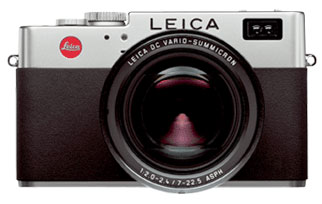
With the Digilux 2, Leica takes a step back to its roots at the same time as it steps into the digital future. From the front, the Leica Digilux 2 has a magnesium metal body with clean lines reminiscent of its legendary M-Series 35mm rangefinder cameras; but a quick glance at the back confirms it is solidly a digital camera, with a large 2.5 in. LCD (211K pixels).
Operation is "analog" with aperture setting and focus on the lens ring, and a shutter speed dial on top. No rangefinder though, but a 235K pixels resolution electronic viewfinder (EVF) with 100% coverage and magnified center for ease of focusing. The lens is a Leica DC Vario-Summicron with large F2.0 aperture at wide-angle and F2.4 at full telephoto. Inside, a 2/3 in. image sensor provides 5 effective megapixels resolution. Images can be saved as RAW. The LEICA name is proudly spelled out up front and we can only hope that the image quality will stand up to the proud heritage behind the name.
The Leica Digilux 2 effectively brings together the best of both worlds and, if it delivers on its promises, may well catapult Leica to the front of the pack with a digital camera that shakes the current conventional wisdom. The Digilux 2 will appeal mostly to advanced amateur photographers.
Supplementary quotations:
Hanns-Peter Cohn, Chairman of Leica Camera AG:
“When you think of real photography, you think of craftsmanship, magic moments and a conscious use of technology. The LEICA DIGILUX 2 represents a commitment to photographic craftsmanship. The positive handling of tradition, even in product development, is also a basis for products that retain their value over time, as is normal for Leica in the analogue world. In this day and age, it is a counterpoint to the mainstream of automation, virtualisation and miniaturisation. It is a counter concept to photo mobiles and photo computers, without losing the advantages of digital technology. The most important things to us are the final picture and creativity, not the question of whether the picture takes an analogue or digital route. In the mature digital photography market, there is room for solutions that bring together the traditional and the modern. I believe that the LEICA DIGILUX 2 is a digital camera in the old photographic style!”
Gero Furchheim, Division Manager Corporate Communications, Leica Camera AG:
“We commissioned the Magnum photographer David Alan Harvey to take a portfolio of photos for us with the new LEICA DIGILUX 2. I met him on a reportage assignment for National Geographic France in Louisiana, to show him an initial prototype. David is a Leica M photographer, who uses a minimum of equipment. At our meeting in a Cajun pub, he had no time for technical explanations. He simply wanted to try out the camera and learn to use it intuitively. He set the shutter speed, aperture and flash in the way he was familiar with from the LEICA M6. After ten minutes he came back. In the can was an atmospheric photo of dancers and an accordion player. David was extremely satisfied with the picture and accepted the camera as a digital extension of his M equipment.“
The LEICA DIGILUX 2 at a glance
Fast 7 – 22.5 mm LEICA DC VARIO SUMMICRON f/2 – f/2.4 ASPH. zoom lens (equivalent to a 28 - 90 mm zoom lens on a 35 mm camera)
2/3" CCD sensor with 5.0 million pixels
Analog photography feeling conveyed by manual setting possibilities directly at the lens
Its traditional clear design readily identifies it as a typical Leica
Transfer-reflexive 2,5“ display with a resolution of 211,000 pixels and outstanding brilliance
Electronic viewfinder with 235,000 pixels that covers 100% of the picture being taken
Extra large picture storage card with 64 MB
Interval timing and control via the PC
Connections: USB 2.0 (High Speed); DC IN; AV output with option of PAL or NTSC; Remote release cable
Extremely robust and long-lived because of the use of high-grade materials and precision fabrication